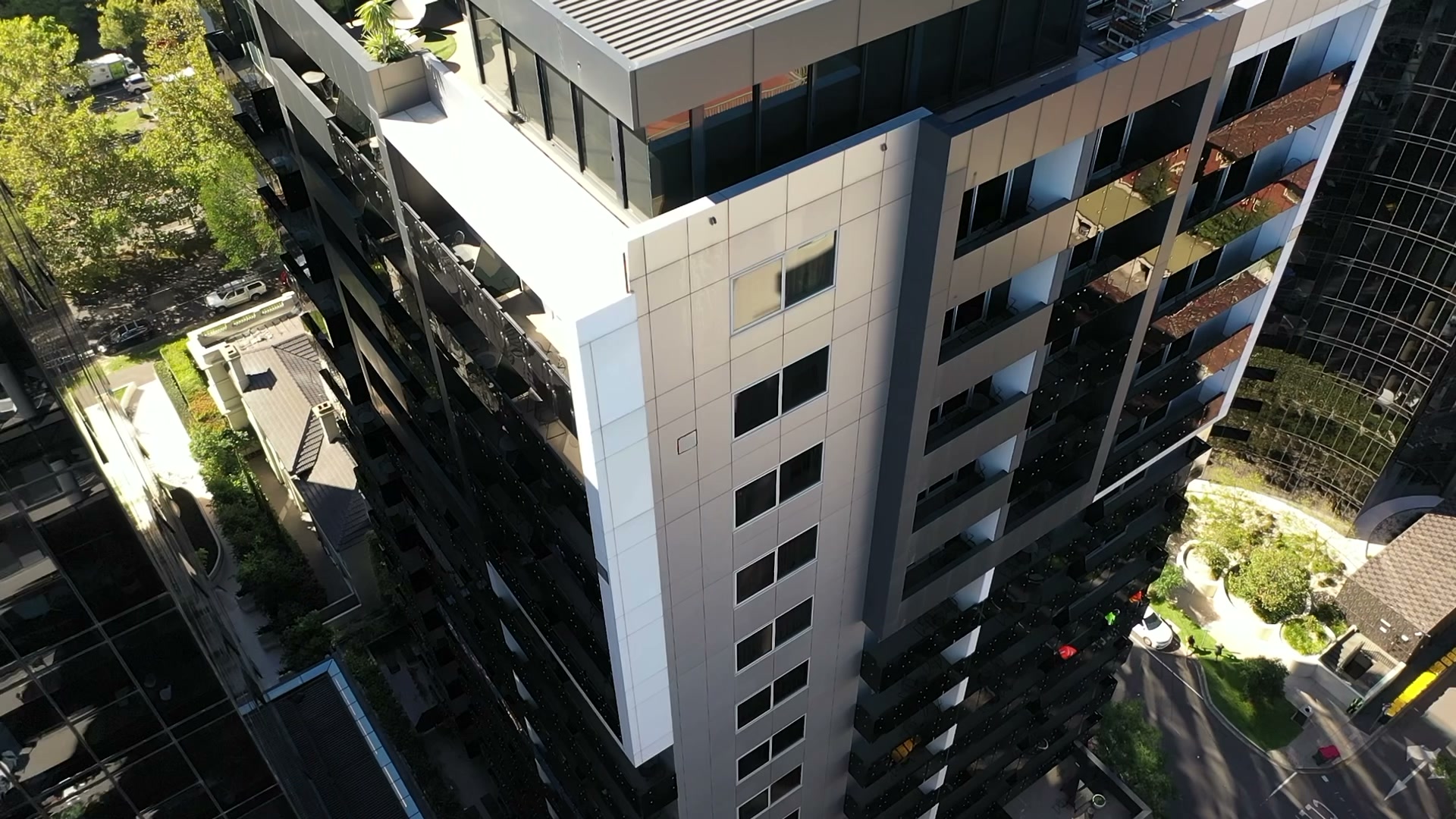
Home/Compliance audits
Know exactly what's on your building.
A compliance audit is the diagnostic entry point of façade remediation, visual survey, drone mapping, invasive sampling and laboratory identification, compiled into a statutory report your insurer, your regulator and your lawyer can act on.
01, Why audits exist
Two fires rewrote the rules for every Victorian façade.
The Lacrosse tower fire in Melbourne in 2014, then Grenfell in 2017, turned combustible cladding from a niche technical question into a statewide compliance programme. Victoria audited its building stock, and thousands of owners learnt their façades had been flagged.
At Lacrosse, fire travelled up the façade at a speed nobody designing the building had planned for. The accelerant was the cladding itself, aluminium composite panel with a combustible polyethylene core. After Grenfell, Victoria moved from concern to action: statewide cladding audits, a dedicated agency in Cladding Safety Victoria, and a regulatory environment where "we assume it's fine" is no longer an acceptable answer for any building owner.
How owners actually find out
Very few owners discover a cladding problem by looking at their building. They discover it in writing, a building notice or order from their council or the Victorian Building Authority, a letter from Cladding Safety Victoria, an insurer's renewal questionnaire that suddenly asks for evidence of façade materials, or a purchaser's lawyer raising it during conveyancing. By that point the question is on the record, and it does not go away until it is answered with evidence.
Why "it looks fine" is not evidence
From the footpath, an ACP panel with a polyethylene core is indistinguishable from a compliant solid aluminium panel. An EPS render system can read as masonry. The material that matters is the one you cannot see, the core, the cavity, the insulation behind the face. That is why a defensible audit must be invasive: the wall has to be opened, sampled and identified in a laboratory. Anything less is an opinion, and opinions do not satisfy regulators, insurers or purchasers.
Most owners don't choose an audit. A letter chooses it for them.
- A building notice or order arrives from council or the Building and Plumbing Commission (BPC)
- Your insurer asks for evidence of façade materials at renewal
- A sale stalls because nobody can vouch for the cladding
02, What we inspect
We open the wall. A drive-by survey is not an audit.
Core materials cannot be identified from the street. A defensible audit layers remote capture, physical sampling and independent laboratory evidence, then squares all of it against what the original build documentation claims is on the building.
Visual façade survey
Elevation-by-elevation mapping of every façade system, panel types, junctions, fixings, penetrations and condition, identifying suspect systems and the right places to sample.
Drone mapping
High-resolution capture of every elevation, including the areas no boom lift reaches. The imagery becomes a permanent orthographic record tied to the materials register.
Invasive sampling
We open the wall at representative locations to identify core materials and cavity construction first-hand, then reinstate every opening weather-tight before we leave site.
Laboratory identification
Samples go to a materials testing laboratory for identification of core composition, the polyethylene content that decides how a panel behaves in fire, in the context of AS 1530.1 combustibility testing.
Build documentation review
Original permits, as-built drawings and specifications, reviewed against what is physically on the wall. The gap between what was documented and what was built usually tells us where to cut.
Cavity & system construction
Sarking, insulation, cavity barriers and fixing methods, because fire behaviour is a property of the whole façade system, not just the panel on its face.
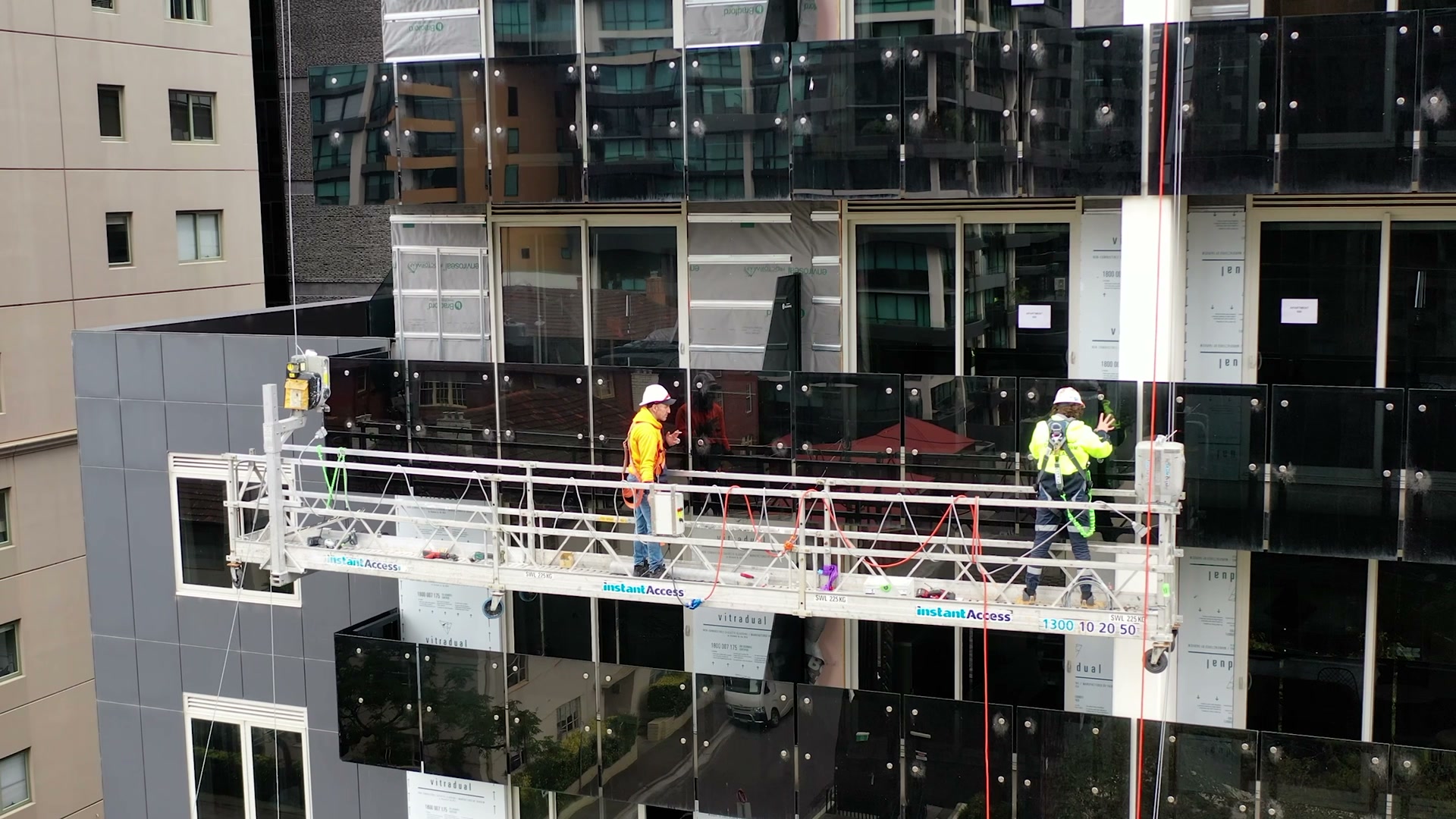 Access planning · every elevation, every level
03, The process
Five steps from unknown to documented.
Every audit follows the same disciplined sequence. You know where the audit is up to at every stage, and every finding is logged the day it is made.
Engage & document review
We start at the paper: building permits, as-built drawings, specifications and any prior reports or notices. This desk phase maps what the building is supposed to be, so the site work can test whether it actually is.
Desk phaseSite inspection & invasive sampling
Elevation-by-elevation visual survey and drone mapping, followed by targeted invasive sampling. We open the wall at agreed locations, log the full system build-up, face, core, cavity, insulation, fixings, and reinstate each opening weather-tight.
On siteLaboratory identification
Samples are identified in a materials testing laboratory, establishing core composition with the rigour of AS 1530.1 combustibility testing behind it. The result is evidence, not a contractor's opinion about what a panel probably is.
Independent evidenceFire-engineering risk review
Identified materials are reviewed with fire engineers against the NCC, considering occupancy, egress, detection and suppression, and how the façade system as a whole would behave in fire, not just the panel in isolation.
Risk in contextStatutory report & materials register
Findings land in a statutory compliance report and a panel-by-panel cladding materials register, written to be handed directly to a building surveyor, an insurer or a purchaser's lawyer without translation.
Deliverable04, What you receive
Documents that do work for you.
An audit that ends in a vague letter is a wasted site visit. Ours ends in four documents, each written for the people who will actually read them.
Cladding materials register
A panel-by-panel record of every façade system on the building, material, core, extent, location and condition. The single source of truth that every later decision refers back to.
Fire-risk assessment
What the identified materials mean for this building specifically, reviewed with fire engineers, weighing occupancy, egress and the building's active and passive fire systems.
Statutory compliance report
Written to the standard a regulator expects, suitable evidence for insurers, building surveyors, Cladding Safety Victoria and a purchaser's solicitor during conveyancing.
Remediation scope & budget pathway
If work is required: a prioritised scope, the realistic compliance pathways, Deemed-to-Satisfy replacement or an engineering-evidenced Performance Solution, and a budget pathway you can plan against.
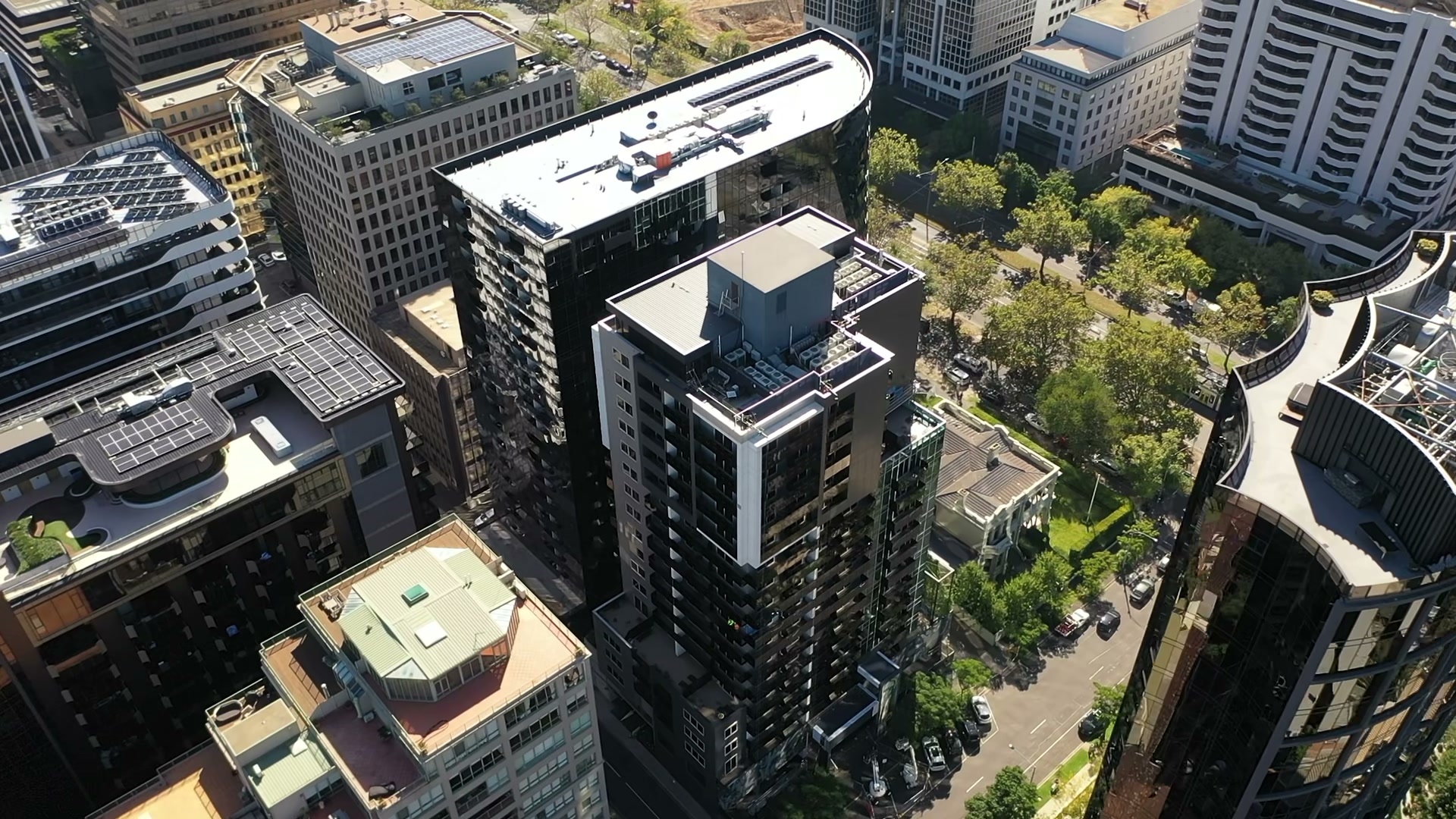 The end state, a documented, insurable asset
05, Who needs one
If any of these is you, the audit comes first.
Different owners arrive at an audit for different reasons. The deliverable is shaped to the decision you actually have to make.
| Who | The usual trigger | What the audit resolves |
|---|---|---|
| Owners corporations | A building notice, a Cladding Safety Victoria letter, or an AGM that cannot move forward without facts | A defensible materials register and a costed pathway lot owners can actually vote on |
| Commercial building owners | Insurance renewal questions, or a portfolio-wide risk review | Laboratory-backed evidence of what is on the wall, and a remediation scope that can be programmed around tenants |
| Purchasers in due diligence | A façade nobody can vouch for during conveyancing | Clarity on remediation exposure before contracts are signed, not after settlement |
| Insurers & brokers | A flagged material with no documentation behind it | Independent identification and a statutory compliance report to hold on file |
We do not chase work outside our specialism, and we do not manufacture work inside it. If the laboratory says your façade is compliant, the report says exactly that. We hand you the evidence, and we leave.
Pro-Build Plus, practice principle06, Questions, answered straight
Compliance audit FAQ.
The questions owners corporations, building managers and purchasers ask us most, answered the way we'd answer them on site.
07, After the audit
The audit is step one. We do the rest, too.
Because Pro-Build Plus delivers the full remediation cycle, the audit report isn't a referral to somebody else, it's the first document of your project, whichever pathway it points to.
Cladding removal
- Staged removal of non-compliant ACP and EPS systems
- Programmed around tenants and operations
- Every removed panel logged against the materials register
Performance Solutions
- Engineering-evidenced NCC compliance pathways
- Equivalent safety without full system replacement
- Certifiable for Victorian building surveyors